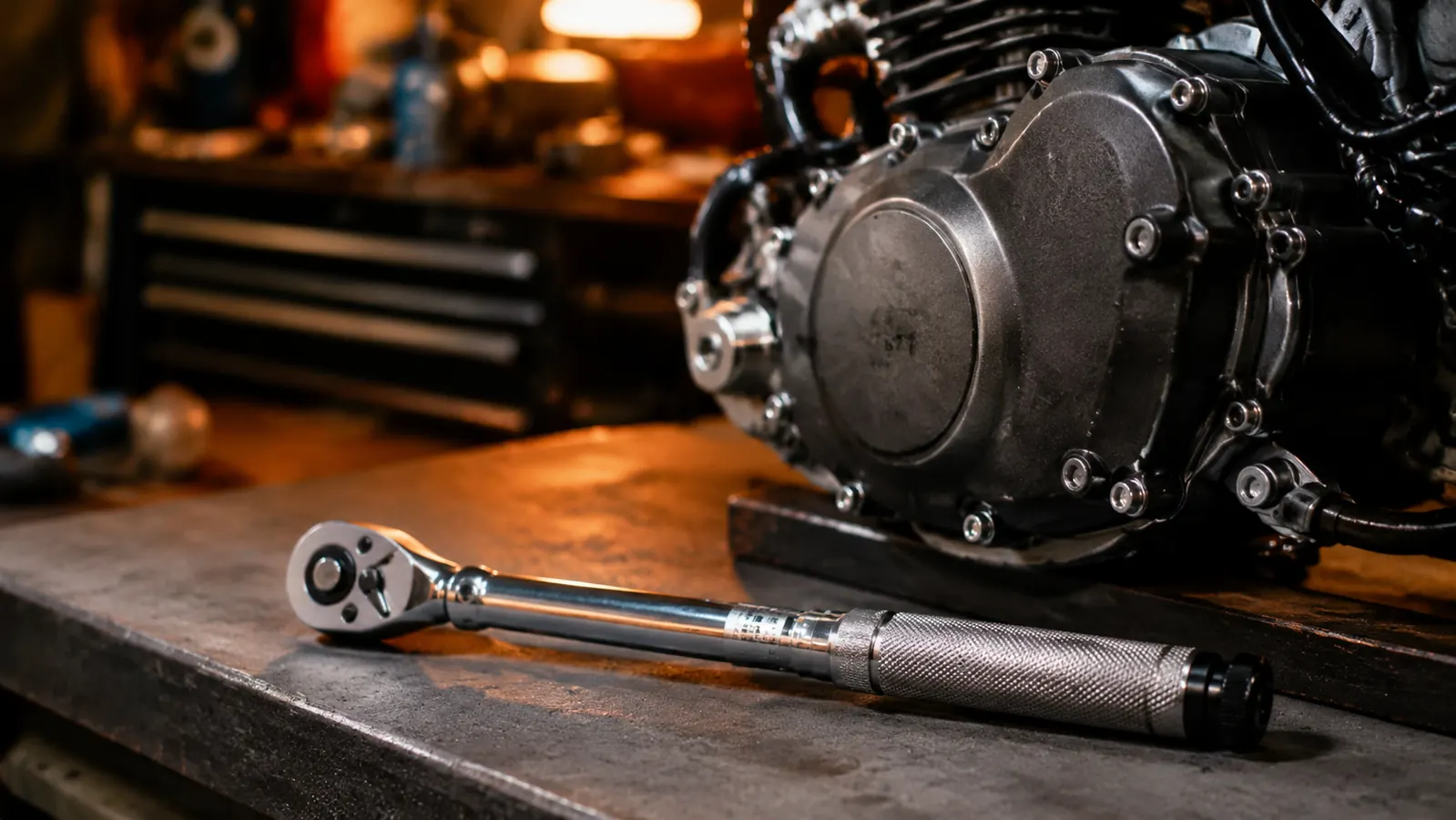
I rebuilt my first top end by feel. Held the ratchet, tightened the head bolts until it felt about right, and buttoned it up proud of myself. The bike ran, for about a month, until a cam cap bolt backed out and I got to do the whole job a second time on a Saturday I'd rather have spent riding. The rebuild went back together with the LEXIVON LX-183 click torque wrench and a service manual, every bolt at its number, and it's still together five thousand miles later. That's the entire reason this tool earns a permanent spot in my box, and it's not the only one.
The click wrench that stops you guessing at a number
A 1/2 inch click torque wrench, set to the spec in your manual, clicks the moment you hit it. That one piece of good habit is what keeps freshly built fasteners from backing out or snapping off.
Amazon Check Today's Price on Amazon →Aluminum cases crack when you guess high
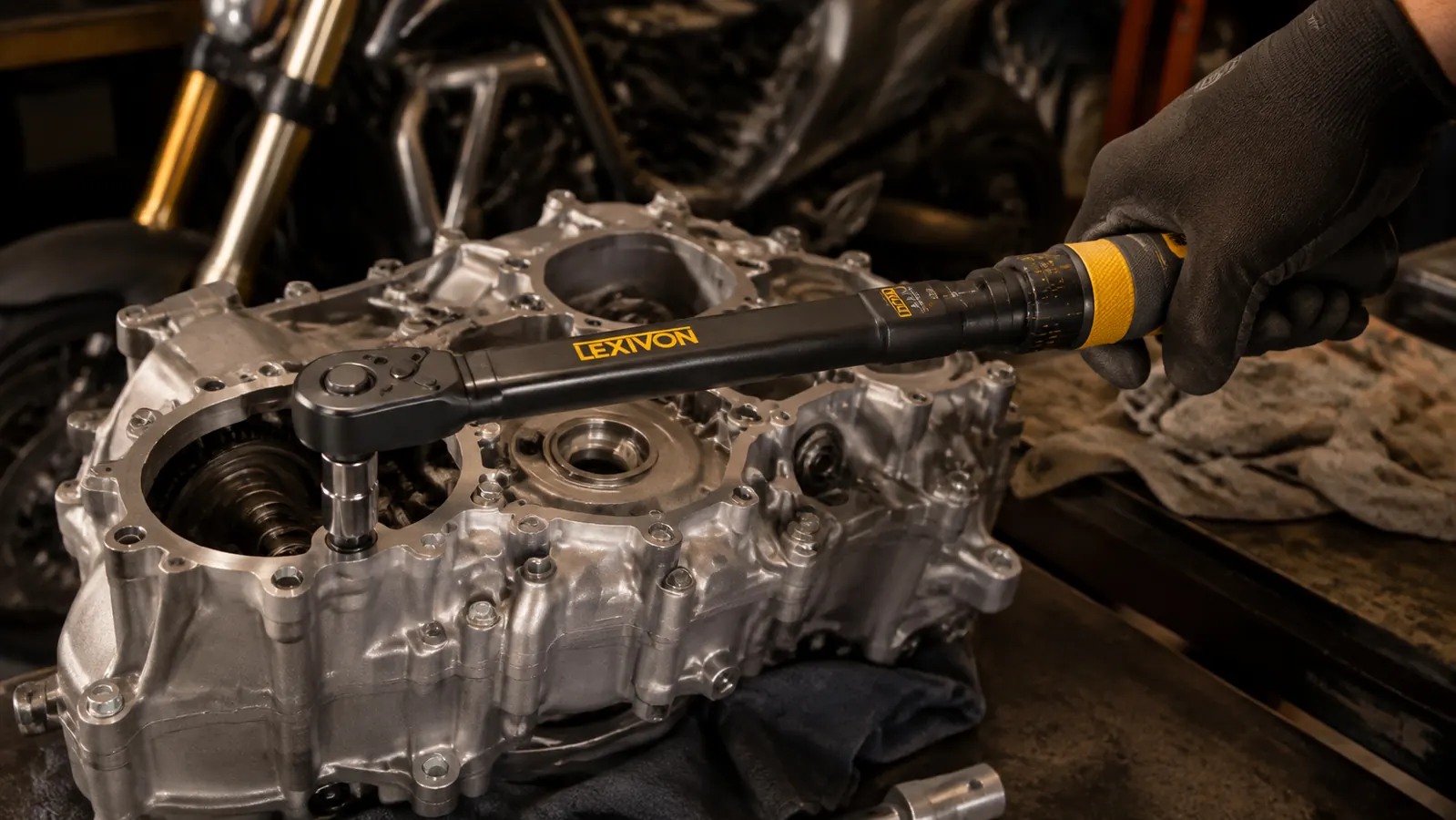
Motorcycle engines are aluminum, and aluminum does not forgive over-torque the way steel does. Go a few ft-lb past spec on a case bolt and you can crack a boss or strip a thread right out of the casting. A torque wrench stops you at the number in the manual, so you never find out the hard way what your castings cost to replace.
Fasteners back out when you guess low
The flip side of guessing is the bolt that's not tight enough. A cam cap bolt torqued short works loose under vibration, and a loose fastener in the valve train is how you get a mess instead of a ride. Click torque gives you a number you can trust, so the parts that are supposed to stay put actually do it.
Head bolts are not a feel-based job
A cylinder head sees heat cycles, pressure spikes, and a gasket that has to crush evenly to hold a seal. I watched a buddy's big twin weep oil out of a head gasket corner because he ran the bolts in a circle instead of the crisscross sequence, and re-tightened them hot on top of a seal that had already seated unevenly. Every head bolt spec has a reason behind it, and the sequence matters as much as the torque. On my own top end I worked the bolts in two or three passes, adding about ten ft-lb at a time in the manual's order, until the wrench clicked at the final number. One wrench set to that number, worked in sequence, is what keeps a top end sealed instead of weeping five hundred miles down the road.
Axle torque is a safety number, not a preference
A rear axle that's under-torqued lets the wheel move in the swingarm, and a front axle that's loose can turn a ride into a faceplant. I torque mine with the bike off the ground so the axle nut pulls true and the spindle isn't loaded, then check it again after the first ride, because a new crush nut will settle a little once things seat. These are the fasteners you should never trust to a feel-based guess. They're the ones where the manual number exists to keep the hardware holding all of you upright.
Rotors warp and calipers bind without a number
Torque your brake rotor bolts unevenly and you can pull the rotor out of flat, which turns into a pulsing lever and a warped piece that needs replacing. There's a spec for rotor bolts, and hitting it in the right pattern keeps the disc true. Same story for caliper bolts: slack means a moving bracket, over-tight means a stripped ear.
Triple clamps need equal pull from both sides
Clamp bolts hold the fork tubes, and if you torque one side harder than the other you can bind a fork tube and kill the steering feel of the whole bike. I work them in a crisscross, one side, then the other, a few ft-lb at a time, and I always pull the bolts back to zero and re-tighten in steps so neither side gets ahead. Torque both sides to the same number and the fork sits true. It's the difference between a bike that tracks straight and one that hangs up on its own clamp.
Cover plates and drain plugs seal on a correct crush
A case cover bolt at spec crushes the gasket just right and keeps oil in the engine. The same logic runs through the drain plug and its crush washer: too hard and you flatten the washer and gall the pan threads, too soft and it drips on the garage floor. I keep the drain plug number for my daily rider in my head because I change that oil every three thousand miles and I want the same crush every time. A torque wrench gives that middle ground every time, which means fewer oil leaks and fewer bolts pulled out of a case you love.
It gives you one consistent story across every bike
If you work on a cruiser, a sport bike, and a project from the 70s, every one of them has a different torque spec for the same-looking bolt. Your memory is not going to keep ten bikes' numbers straight. A click wrench and a manual mean you set the number fresh every time instead of trusting that it always felt the same, because it never does.
It outs the previous owner's mistakes
Buy a used bike and it's a coin flip whether the last shop torqued anything to spec or just sent it with an impact gun. I brought home an old standard once where the rear sprocket bolts were so loose I could turn them with my fingers, and a front rotor so over-torqued the disc had a visible warp. Running a click wrench over the obvious fasteners when you bring one home tells you in thirty seconds if they were over-torqued or left loose. You find out before it fails on the road, which is when it stops being a repair and starts being a tow.
It costs less than the one fastener it saves
A LEXIVON LX-183 sells for about the price of a single cam cap or a rotor bolt kit. It earns that back the first time it keeps you from stripping a thread or snapping a stud, never mind the rebuild it saves you from repeating. Compare today's price against one shop trip to fix a stripped thread and the math is already over.
Look, I still use a ratchet and an impact gun for a lot of the shop. Not everything on a bike deserves a torque wrench, and any builder who says they torque every single bolt to spec is either lying or slower than me. But engine internals, axles, brakes, and clamps are not the place to guess. Those are the numbers that keep the build together and keep you upright, and a click torque wrench is the only honest way to hit them, and the LEXIVON is the one I reach for.
What I'd Skip
I wouldn't use a 1/2 inch drive wrench for the tiny 6mm and 8mm bolts all over a modern bike, because small fasteners often spec below the low end of that range. For those you want a 1/4 or 3/8 inch drive wrench that reads down toward single digits. And every click wrench needs to be re-set to zero and treated gently; drop it on the concrete and the calibration can shift, so don't use a banged-up wrench on a rod bearing and blame the tool. For the everyday engine, axle, and brake torque a builder actually does, a single 1/2 inch click wrench covers the vast majority of the numbers you will ever need.
The rebuild went back together with a torque wrench and a service manual, every bolt at its number, and it's still together five thousand miles later.
If you build any part of a motorcycle, this is the cheap tool that keeps the build together
Set it to the number, wait for the click, and stop trusting feel on the fasteners that matter. It's a small, honest habit that saves you from stripping threads and repeating rebuilds.
Amazon Check Today's Price on Amazon →