
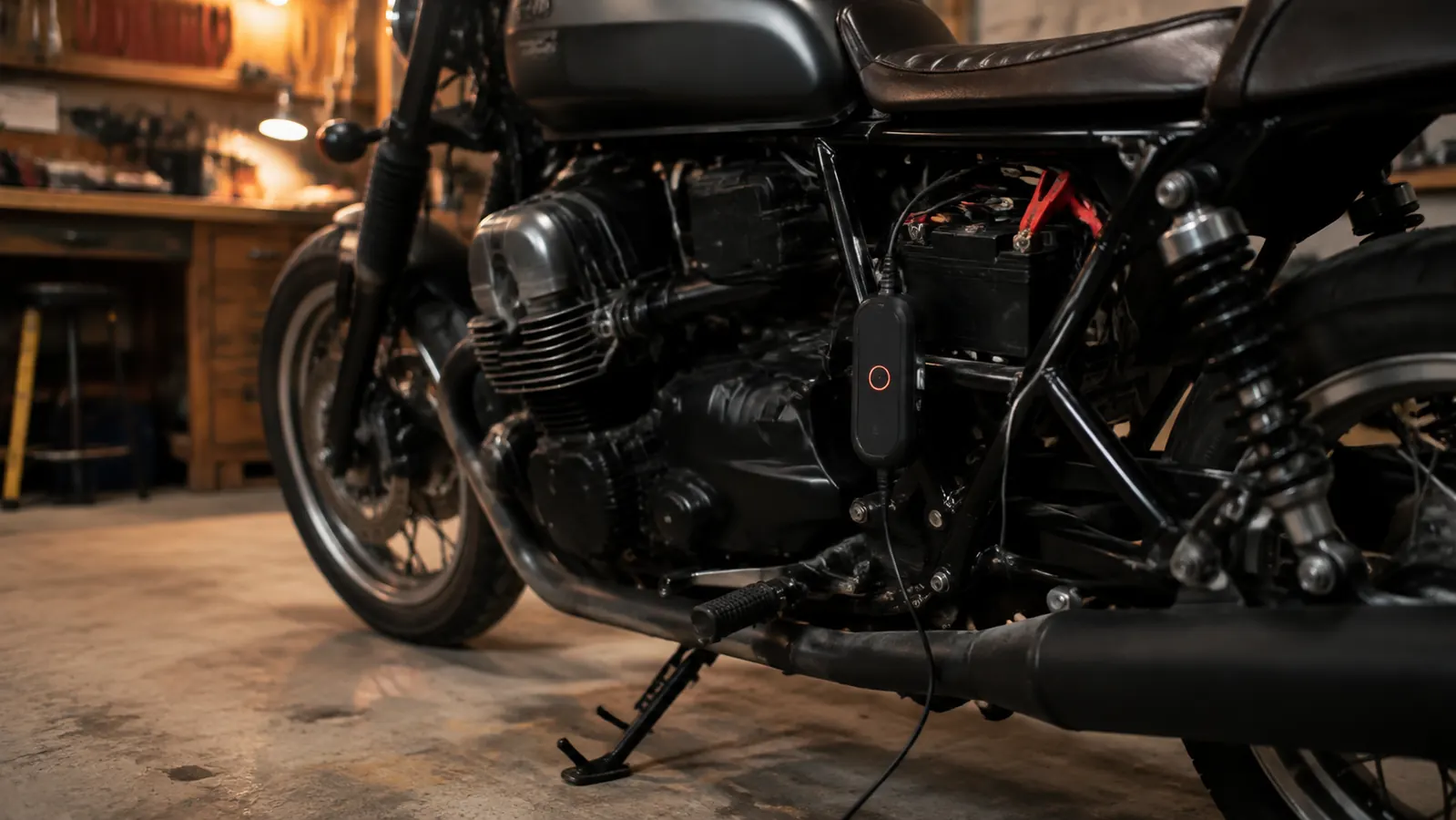
It starts the same way every fall. You park a bike in October convinced you will ride it again by Thanksgiving, and then a job takes the whole garage and suddenly it is January and that battery has been draining to flat for three months. I have killed more motorcycle batteries by neglect than by any starter that actually failed, and a flat lead-acid cell left to sit is exactly how a battery dies for good. The plates sulfate, the charge that is left sinks to nothing, and by March you are staring at a battery that reads seven volts and will not hold a crank no matter what you hook to it.
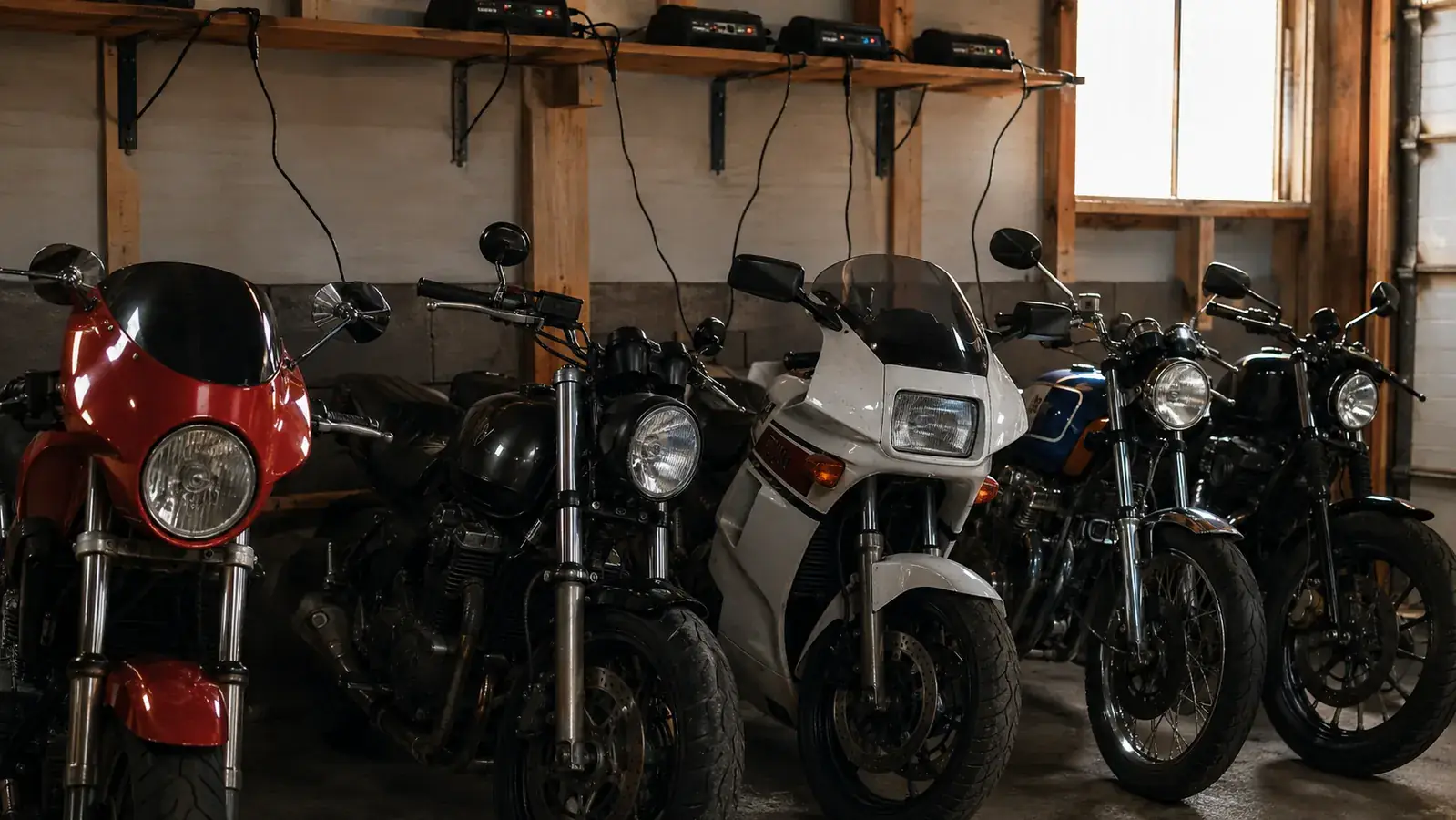
So two winters ago I stopped trusting my memory and started trusting a little black box. I wired a Battery Tender Junior onto every bike in the shop, five of them total, including the hot rod and the big-rig spares I keep charged for the tow yard. This is the long-term version after two full seasons of use, both the part that works and the part you hear about thirdhand that is mostly myth. I have no allegiance to the brand, I run NOCO units on the bench bikes, but the Junior is the one I reach for when I want a battery to be alive six months from now and not think about it in between.
The Quick Verdict
The Battery Tender Junior is the right maintainer for a bike you park and forget. It will not resurrect a battery that is already flat, so pair it with a small boost charger for that job and let the Junior do what it does best: hold a good battery forever.
Amazon Check Today's Price →Stop finding a dead battery every spring. Put a Junior on the bike before you park it.
The battery that kills your first ride of the season is the one you let sit flat all winter. A Junior keeps a good battery ready to crank for months, and it costs less than one tow or one replacement battery.
Amazon Check Today's Price on Amazon →How I've Used It
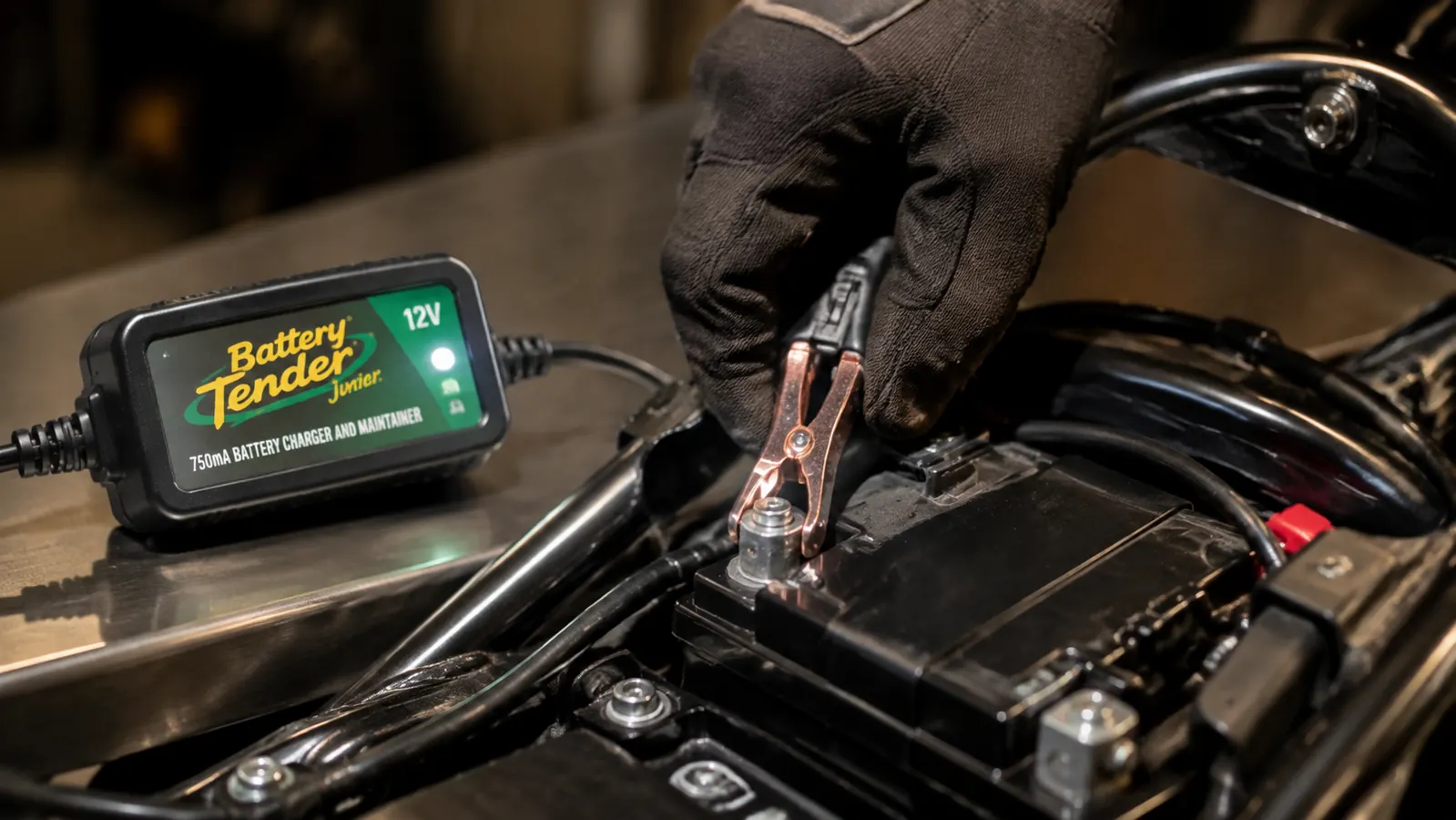
My setup is not one tender on one bike. I run five Juniors, one for each long-term sled: a 2019 Suzuki V-Strom 650 that sits from October to April, a 1976 CB550 cafe project that lives on the bench, a 1980s shovelhead that I am forever fiddling with, plus a trickle on the 1969 hot rod and a spare for the big-rig jump pack. Two of the V-Strom and the shovelhead are wired with the permanent ring-terminal pigtail that comes in the box, which is the right way to do it. The ring terminals go straight on the battery posts, the other end of the pigtail tucks under the seat or up the frame, and the maintainer plugs into it through a weatherproof connector.
I clipped the harness to the CB550 with the alligator clamps instead. Both ways work, but the pigtail is the better long-term answer because you are not fighting the battery every time and you are not leaving a bare clamp flopping against the frame where it can short out on steel. The Junior reads the voltage, charges up to a 12.75V ceiling at 750mA, then drops to a float that holds it there. It will do that for months without cooking a plate, which is the whole point of a maintainer and the reason you do not use a full charger for this job.
What actually sold me was the winter of 2024 to 2025. The V-Strom sat on the Junior from the first hard freeze until a warm February afternoon, five months without being started once, and it fired on the third kick with a full head of voltage. That used to be a jump-box morning and a trip to the charger every single year. The same unit ran nearly nonstop through a month of single-digit nights in an unheated shop and never blinked, which told me the low-temp reputation is earned. Cold is a battery's real enemy, self-discharge climbs as the temperature falls, and a maintainer that still floats clean at twenty below is doing its job.
One habit I picked up that keeps the whole system honest: before anything goes to bed for winter, I clean the terminal posts and torque the pigtail ring down tight. A layer of crud under a loose connection reads as a dead cell to the maintainer, and then you chase a phantom drain all spring. Ten minutes at park time saves a morning of head-scratching later, and it also tells me right away which bike has a genuine problem with draw versus one that just had a dirty post. On the shovelhead, which has a small parasitic draw from an old regulator, I found the Junior actually caught up with the drain overnight, which is more than the battery alone was ever doing.
What the Junior Does Right
First, the 750mA maintenance rate is gentle, and gentle is what you want for a battery that will sit for weeks. A full-size charger hammering a small bike battery is how you boil the electrolyte out of a fresh Yuasa by spring. The Junior floats instead of forcing, so it keeps a healthy battery exactly where it should be and no hotter. That alone is worth the shelf space. I have measured the ceiling voltage on the V-Strom over a few days and it sits steady, no creeping overcharge, no sagging charge, just a flat line that holds.
Second, it is genuinely automatic. I have left it plugged in for a month, unplugged it, let the bike sit, and plugged it back in without thinking once. It reads the state and decides what to do. There is no switch, no mode selection, no way to get it wrong. That sounds trivial until you remember a maintainer is only useful if you actually use it, and the ones with a row of buttons on the front are the ones that sit in the box in March. The Junior has one job and one light, and I have never once had to read the manual to figure out what it was doing.
Third, the cost of entry. A Junior is one of the cheapest maintenance investments in the shop, up there with an exhaust-wrap roll, and it protects a component that costs several times more to replace. A good motorcycle battery is not cheap to swap out, and a maintainer at today's price keeping it alive for years is the easiest math on the bench. And because it is cheap, you can run one per parked vehicle instead of playing musical chargers, which is the arrangement that actually sticks. Nobody reconfigures a single shared charger every time the bike lineup changes. Per-sled wiring is what survives contact with real life.
The V-Strom sat on the Junior for five months without being started once, and it fired on the third kick with a full head of voltage. That used to be a jump-box morning every year.
Where It Falls Short
Now the honest part. The Junior is a maintainer, not a charger, and the 750mA rate is the reason. If a battery is already flat, say the kill switch was left on for two weeks or the bike sat on a dead cell all winter, the Junior will eventually bring it back, but it can take a day or two and it may not finish the job at all if the cell has sulfated. I had a sealed battery in the CB550 that read under 8 volts in the spring of 2025, and the Junior spent a whole weekend on it and never got it past a weak crank. That battery was done, and no maintainer was going to fix it.
The other thing nobody tells you is the desulfation story. The Junior runs a desulfation cycle that is real, but it only runs such a cycle when it sees a battery above a minimum voltage threshold. It will not rescue a heavily sulfated battery sitting at six volts. If you want to revive a genuinely worn battery, you want a dedicated desulfator or a smarter unit with a repair mode, not the Junior. Buy the Junior to keep a good battery good, and treat dead-battery revival as a separate tool with its own shelf space. I say this because I have seen guys buy a Junior hoping it will resurrect a battery a slow drain killed last year, and it simply cannot do that.
And a nitpick I will flag because I live with five of them: the 6-foot lead is serviceable but not generous, so on a bike where the battery sits awkwardly you end up wrapping the cord around the foot peg to get slack. On the CB550, where the battery hides under the seat and the box wants to hang off the frame, I had to find a mounting spot that kept the lead from pulling on the connector. It is not a dealbreaker, it just makes you pick your mounting spot carefully the first time instead of on day ninety.
Alternatives I've Had on the Bench
I am not a one-tool guy, and the Junior has company on my shelves. I keep a full-size smart charger for garage duty, the kind that can force a dead battery back into the world, and I have a NOCO GENIUS1 that I reach for on the bench bikes because it adds a repair mode the Junior does not have. The GENIUS1 also handles 6V batteries, which matters if you run old bikes with 6V electrical systems, and the Junior does not do 6V at all. For my 6V-era projects, the Junior simply does not apply, and pretending otherwise is how you cook a six-volt cell.
But here is the thing a season of switching around taught me: for the job of holding a healthy battery over a long sit, the Junior is every bit as reliable as the more expensive units, and its single job is all it needs to do. The GENIUS1 spends most of its winter doing exactly what a Junior does, just with more modes I rarely touch. I wound up running the GENIUS1 on the 6V bikes and Juniors everywhere else, which is the honest division of labor. I have also owned the old-school manual trickle chargers that never shut off, and those are the reason I will not run anything like them on a modern sealed battery.
So if you already own a smarter charger, you do not need a Junior, run what you have. But if you are buying your first maintainer and every bike in the shop is 12V, the Junior gives you the least to understand and the least that can go wrong, and that is worth a lot when the whole point is to not have to think about it all winter. The fewer decisions a storage setup asks of you, the more likely it is still running in March.
The Pigtail Versus the Clamps
If you take one piece of advice from this review, it is to spend the extra five minutes and use the ring-terminal pigtail that comes in the box rather than the alligator clamps. The clamps work, and I use them on the bench bikes, but they sit loose and they invite a short if a wrench touches the wrong terminal. The pigtail bolts to the posts, tucks away, and gives you a clean weatherproof plug you can reach without pulling the seat. Once it is on, the maintainer becomes a five-second job, which means you will actually do it every time instead of only when you remember.
My CB550 wears the pigtail now after I got tired of fishing clamp leads out from under the tank. The V-Strom wears it permanently and the plug hangs right where the tail of the seat meets the frame. Two winters, no corrosion, no loose connection, no drama. I also route the pigtail away from the exhaust side and use a small zip tie to keep it off moving parts. If you own a Battery Tender Junior, the pigtail is the whole secret to it being a maintenance habit instead of a once-a-fall chore.
What I Liked
- Genuinely automatic, set it and forget it, nothing to get wrong
- Gentle 750mA float that will not cook a plate over months
- Ring-terminal pigtail makes hookup a five-second job
- Wears well, the plastic unit and leads have survived two winters of shop dust and cold
- Cheap enough to run one per bike instead of shuffling a single unit around
Where It Falls Short
- At 750mA it is a maintainer, not a charger, and slow on an already-flat battery
- Will not reliably revive a sulfated battery, that needs a repair-mode charger
- Desulfation cycle only triggers above a minimum voltage
- The 6-foot lead forces careful mounting on some bikes
Who This Is For
The Battery Tender Junior is for anyone with a bike or a project that sits for a week or more. If you ride daily and your bike never sleeps, you do not need it, but the moment there is a season, a backup, a barn find, or a project that waits its turn on the bench, a Junior earns its place. It is also the cheapest insurance there is if you own a hot rod or a second vehicle that does ten starts a year, because nothing kills a battery faster than a long sit on a load and a slow electrical draw.
I would especially point the Junior at the guy with more than one bike. The price lets you afford one per sled, and once every parked bike has its own maintainer you stop playing the rotation game and every battery stays healthy on its own schedule. It is also a genuinely good gift for a rider who is not a wrench, because there is almost nothing to learn and no way to set it up wrong.
Who Should Skip It
Skip the Junior if your battery is already dead and you are hoping this will save it. That is the wrong tool for the job. A battery sitting under 8 volts, one that has sulfated from a long flat sit, needs a dedicated desulfating charger with a repair mode before a maintainer can help it. I have revived worn cells with a bigger smart charger that I would not trust a Junior to touch, and I would rather see you buy the repair tool than watch a Junior struggle for a weekend.
And if you run a battery that sits so flat, so often that you are constantly reviving it, the honest fix is probably the battery, not a better tender. Two winters taught me that a Junior keeps a healthy battery alive for years, but no maintainer in the world rescues a battery that should have been replaced last spring. The Junior is a first line of defense, not a resurrection kit, and keeping that straight is what separates a satisfied owner from a frustrated one.
Wire a Junior on now, and skip the jump box in spring.
Five bikes, two winters, zero dead-battery mornings since I stopped trusting my memory. A Battery Tender Junior on each parked bike is the cheapest reliability mod in the shop.
Amazon Check Today's Price on Amazon →