
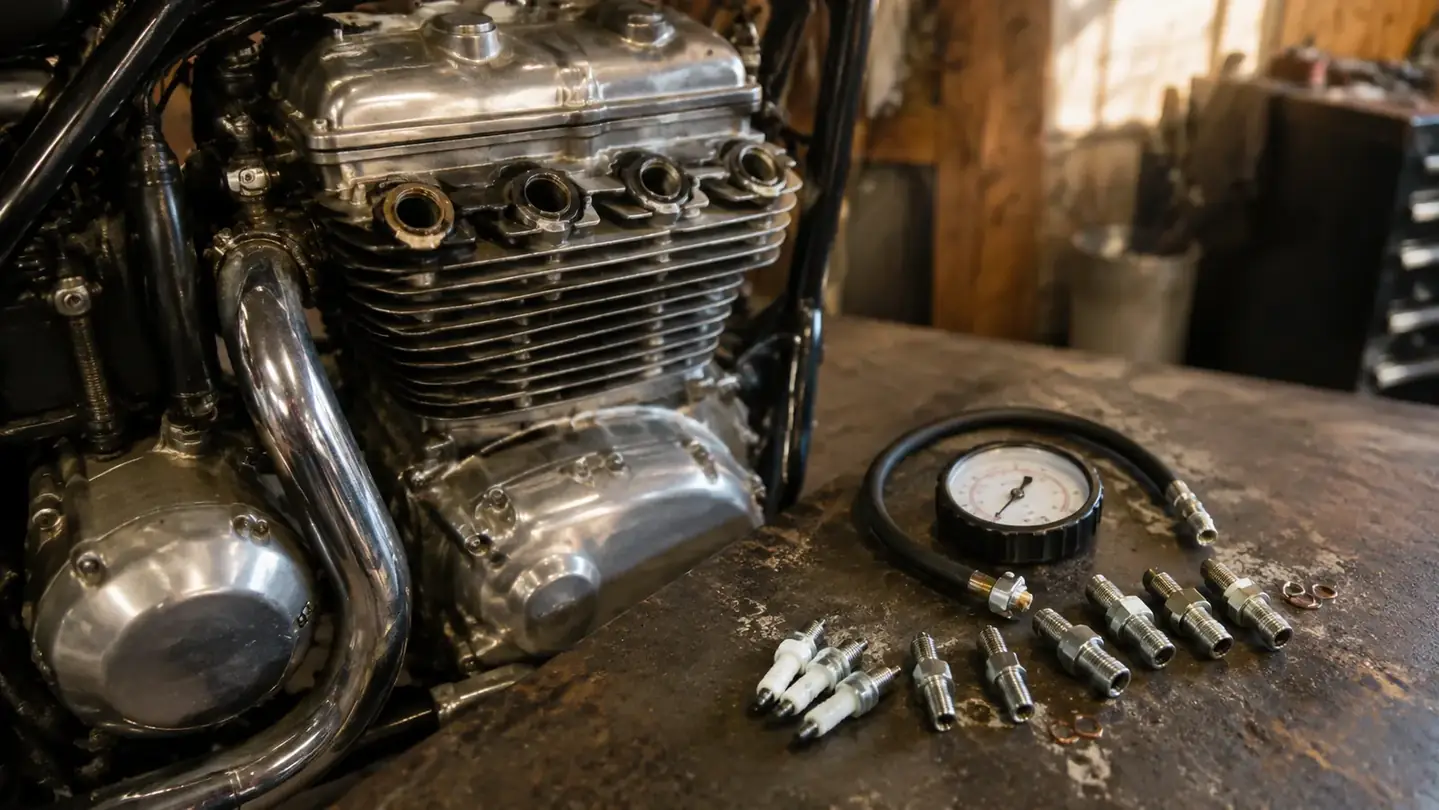
The bike came back from a Friday ride sounding like it was arguing with itself. It fired, it idled, but it was down on power and spitting through the pipe on the left side, and the harder I rode it the more it sounded like it was running out of breath. If you have been around old twins long enough you know that noise. It is the sound of a theory forming, and before I started running down theories I pulled the plugs and reached for the BETOOLL HW0130 compression tester kit that lives on my bench. Cheap tool, one job, and it brings a number instead of a guess.
Theory one was valves. Theory two was rings. One means lapping the seats and a set of valve springs, the other means pulling the jug or a full top end. Either way the estimate was real money and a weekend on the bench, and I was not about to throw parts at a guess when the two fixes cost that differently. A compression gauge takes those two theories and settles them in about four minutes. I have done plenty of wrenching by feel and by story, but on this one I wanted a number.
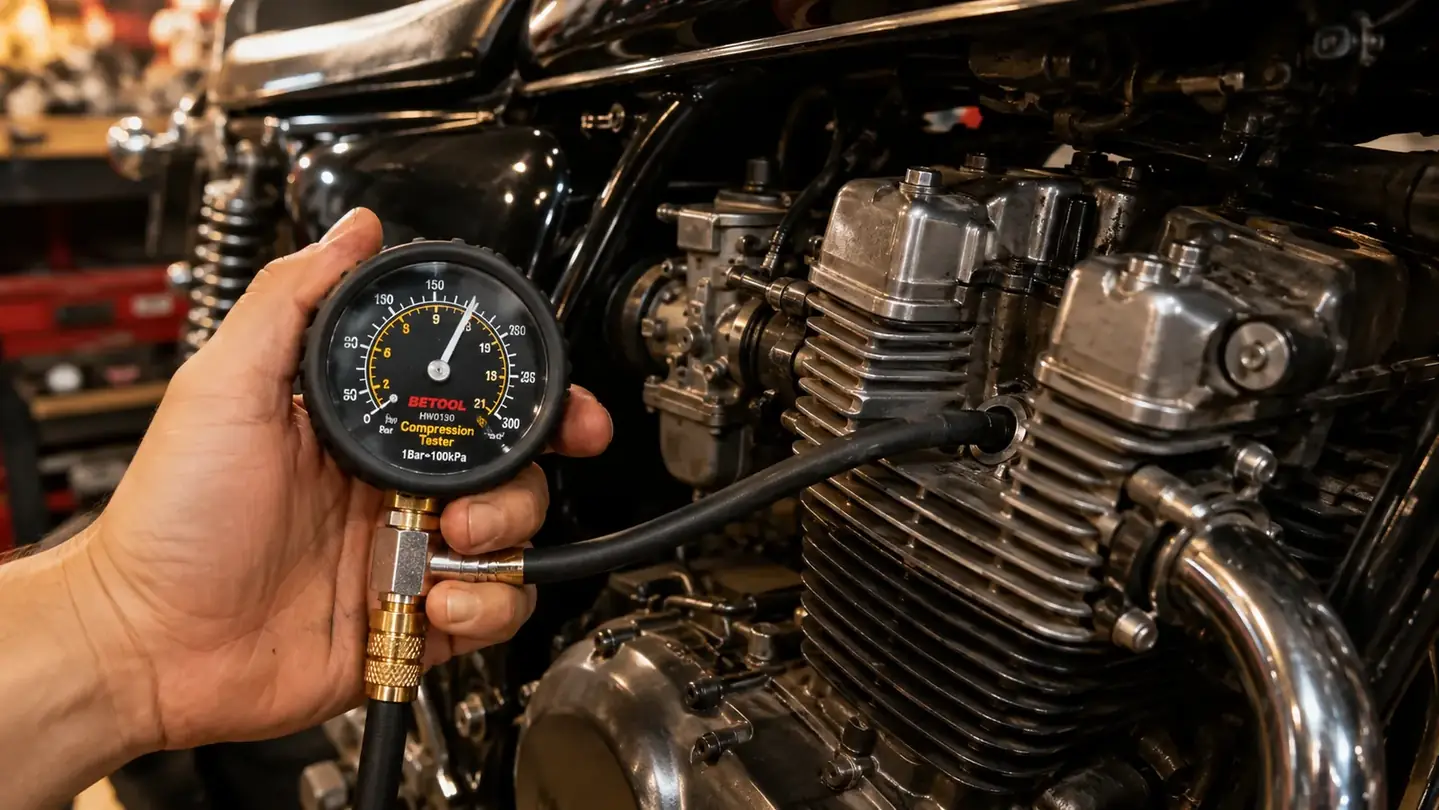
The BETOOLL HW0130 is the kit every home mechanic ends up reading about. It comes with the gauge, the hose, and a pile of threaded adapters that screw into most any spark plug hole you will meet, so it works on my twin and on the big rigs and the old hot rods too. Throttle wide open, kill switch off, crank until the needle stops climbing. On a bike without a starter you kick it enough to get a full reading, and the gauge holds the highest reading on the needle, so you do not have to watch it the whole time.
The left cylinder read 105, the right read 78. Same head, same fuel, same ignition, one dead pull apart. A 27-pound difference like that is not a carburetor problem. That is mechanical, and it is not the valves.
Get a Number Before You Order Parts
A compression check tells you more about an engine than any spec sheet. The BETOOLL HW0130 kit reads your bike before you spend a dime on parts.
Amazon Check Today's Price on Amazon →That spread is the whole story. If it were valves it would usually pull both cylinders, or at least it would not land that far apart on a bike that idled fine. A big gap between two cylinders that share a carb, a coil, and a tank points straight at rings or bore on the low side. I followed the BETOOLL reading with a wet test, a spoonful of oil down the plug hole on the low cylinder, and the number climbed back up. Oil sealing the bore is the classic confirmation that the ring is what is tired. Valves do not care if you add oil.
What that one reading did was keep me from tearing down the wrong end of the motor, and from ordering the wrong half of the parts list. I pulled the low cylinder, and there it was, a scored wall and a ring that had given up. Nothing that would have shown up in the tank or the carbs, but the gauge saw it in about four minutes. The cylinder got honed and re-ringed, the head stayed on, and the bike was back together with a fraction of the parts I had been bracing to buy.
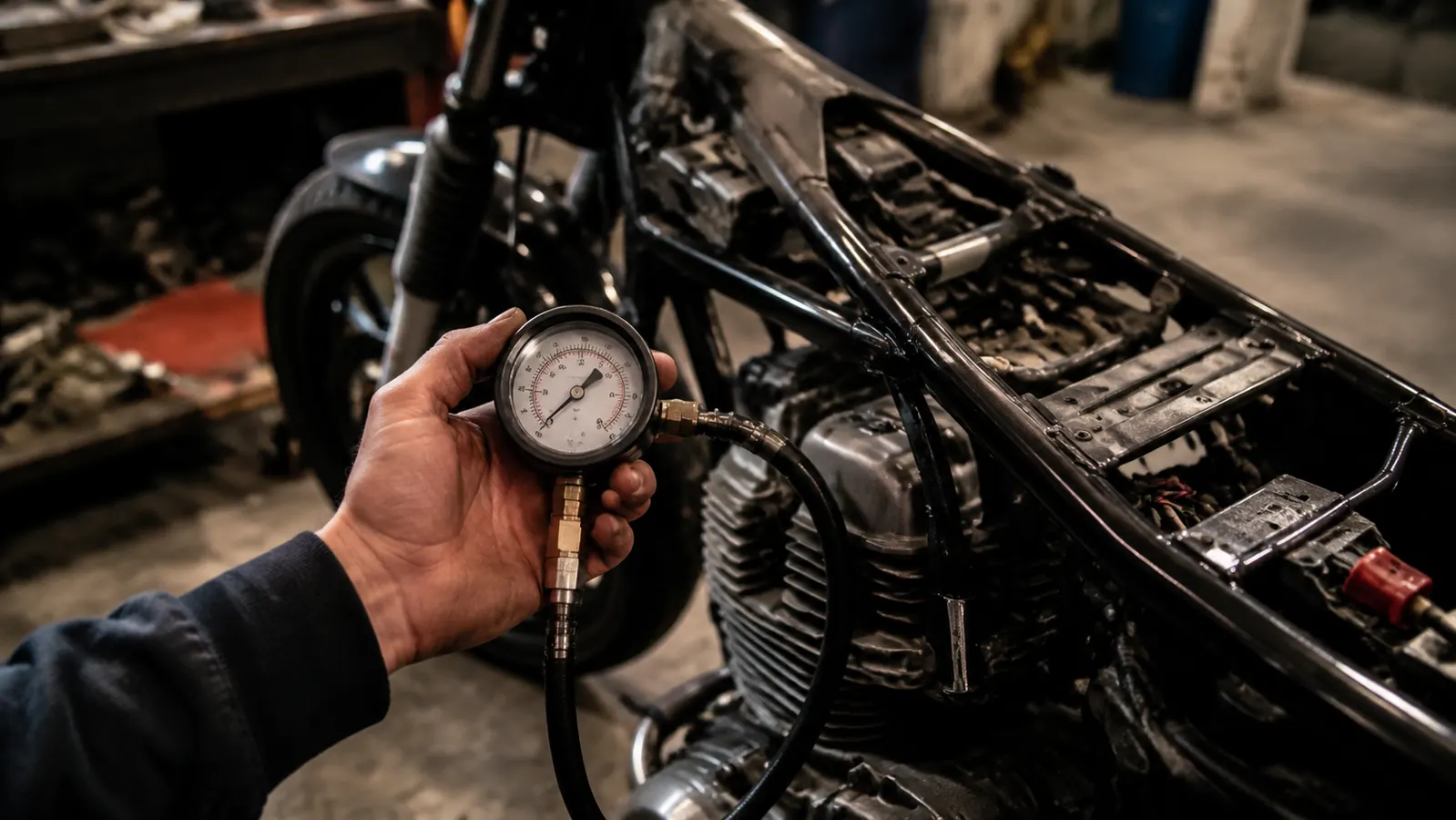
What a compression test really does is take the guesswork out of the decision. The BETOOLL kit came with the gauge, the hose, and a tray of threaded adapters that screw into the plug holes on everything from my twin to the big rig cylinders, and I have yet to run into a plug hole it did not have a fitting for. You screw the right adapter in by hand, crank the engine, and read the needle where it holds. That is the whole tool. There is no battery and nothing to calibrate, which is exactly what I want out of a gauge that sits in a drawer for months at a time.
Over the years that same BETOOLL kit has read every engine in my shed. It is not a lab instrument, it is a dependable gauge with a dose of honesty in it, and you treat it that way. I check it against a known-good motor now and then to make sure it still reads where it should, and it does. For the handful of dollars it costs and the rebuilds it has caught, it has paid for itself more times than I can count.
The part I keep going back to is that it saved me from spending money on a problem I did not have. I was two clicks away from ordering valve springs and lap compound off a guess. Instead I bought a cheap tester, ran one test, and learned the actual answer before I handed over a dime. That is worth more than the tool, and the tool was already cheap.
What I'd Tell You If We Were Sitting at My Kitchen Table
If an old engine is running rough and you are already fishing through a catalog of parts, stop and buy a compression tester before you order. It is one of the cheapest things you can own and it is the fastest way to find out whether your problem is inside the cylinder or in the tune around it. The BETOOLL HW0130 covers most any spark plug hole with its adapters, holds the reading so you can see it, and gets out of the way for twenty years. It will not replace a leakdown tester and it is not a lab gauge, but for finding a worn ring before you tear into the wrong end of a motor, it does the job every time. I was one bad guess away from a rebuild I did not need. The gauge caught it first.
Keep a Compression Reading in Your Corner
Before you order parts off a guess, get a number. The BETOOLL HW0130 tells you whether your trouble is in the cylinder or the tune, before you spend the money.
Amazon Check Today's Price on Amazon →