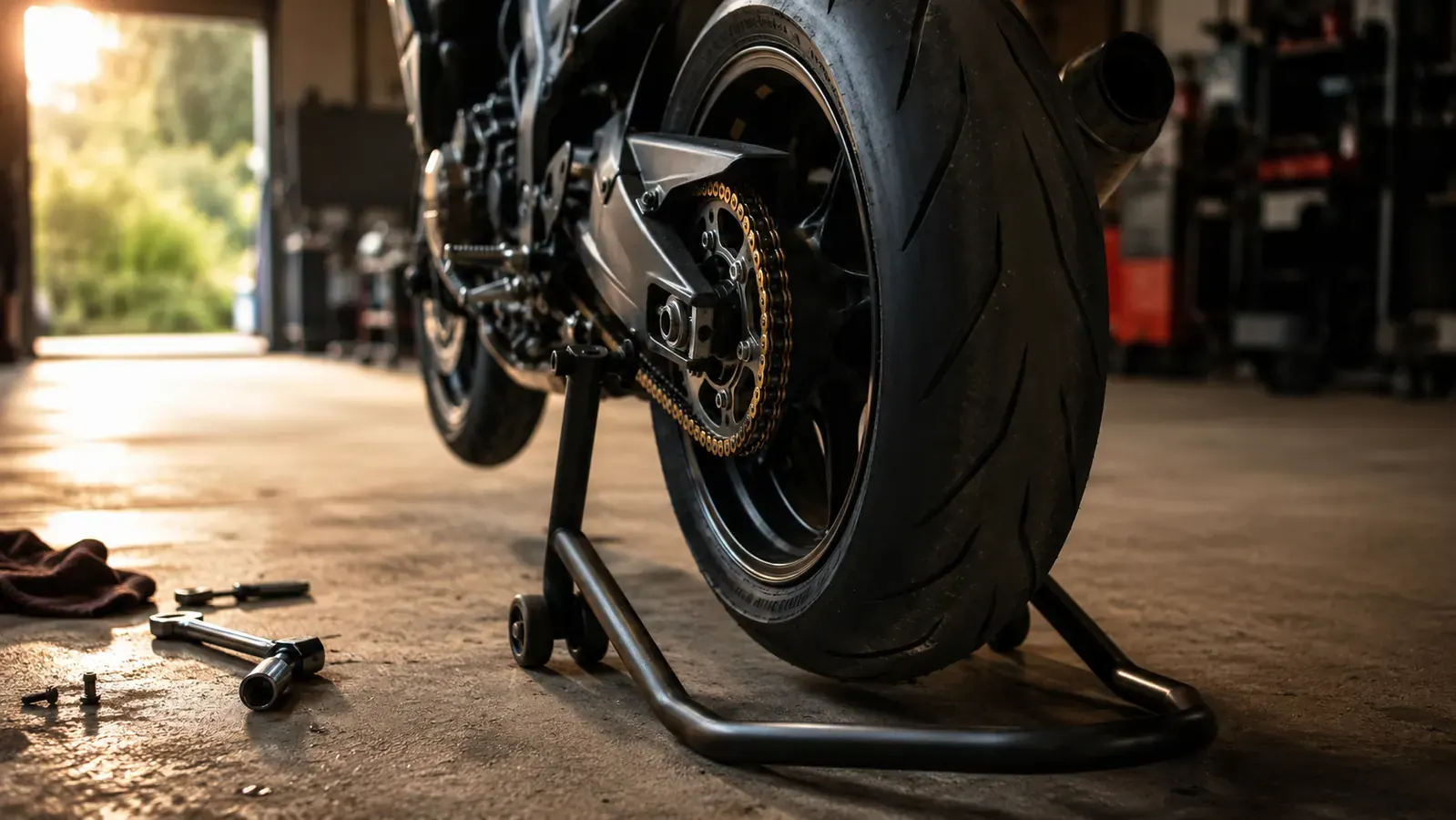
People in the comments love to tell a new builder to buy a rear stand, and half the time they get these two mixed up. They are not the same tool, and knowing the difference saves you from buying the wrong one and then blaming the part. The GRAND PITSTOP Groller is a roller stand: it cradles the rear wheel from below on a set of bearings so the tire spins free while you clean the chain, polish the rim, or lube the rollers. The VEVOR rear stand lifts the wheel clear of the floor on spools or paddles so you can pull the wheel, torque the axle, or park the bike for the winter. I run both in my shop, and the honest answer is that you probably need one, and depending on how you wrench, you might need both. Let me lay out which does what and where each one falls short.
Short version: for chain cleaning, tire detail, and nudging the bike around a tight shop, the GRAND PITSTOP wins every time. For pulling a wheel or doing real rear-end work, the VEVOR is the right tool and the roller cannot fill in for it. My own garage is proof of both. I roll a bike up on the GRAND PITSTOP every couple of weeks for chain service, and the same bike sits on the VEVOR whenever the rear wheel has to come off. You are not choosing between a good stand and a bad stand. You are choosing between two different jobs, and the stand that wins depends entirely on which job you do more.
| GRAND PITSTOP Groller | VEVOR Rear Stand | |
|---|---|---|
| How it holds the bike | Cradles the rear wheel in bearings so it spins free | Lifts the wheel clear on spools or paddles, tire off the floor |
| The job it is built for | Chain cleaning and lube, tire polishing, light wheel work | Wheel removal, axle service, storage, suspension work |
| Can you pull the rear wheel? | No, the tire stays in the cradle | Yes, the wheel drops free in minutes |
| Weight capacity | Rated to 600 lb, comfortable under touring bikes | Solid for street and sport bikes, some friction-fit limits |
| Tire width | Capped around 240mm, snug on fat rear tires | Spools clear of the tire, works on wide rubber |
| Chain work one handed | Spin the wheel and hit every roller without moving the socket | Wheel sits still, you have to reposition around the chain |
| Moving the bike in the shop | Rolls the whole bike forward and back in a tight space | Stands it in place, does not roll |
| Floor footprint | Short and wide, tucks under the bike | Taller stance, more reach but more room to store |
Where GRAND PITSTOP Wins
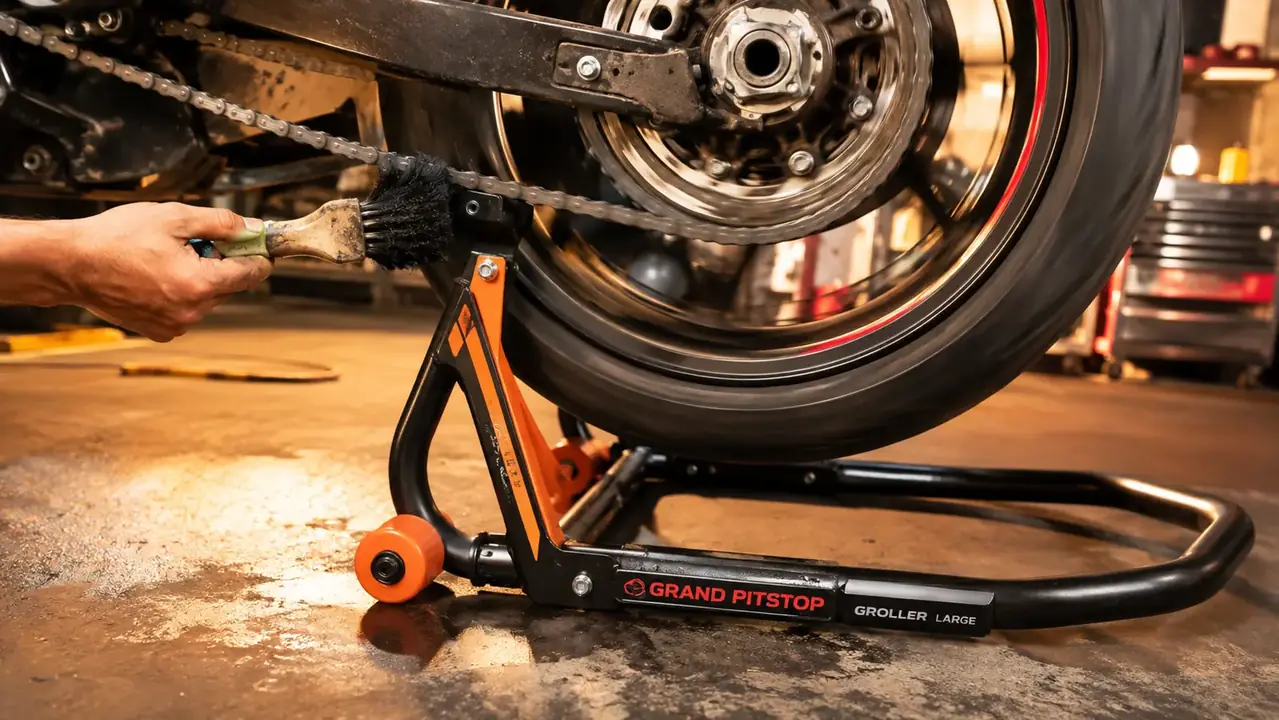
Running the chain clean and lubed is the single most repeated job on any chain-drive bike, and the GRAND PITSTOP Groller turns it from a 20 minute kneel on the side stand into a five minute spin. The rear wheel sits in the cradle on a pair of bearings, so you can reach between the swingarm and the rear fender with a brush, spin the wheel by hand, and hit every roller in one pass instead of doing two positions and walking around. For a guy who changes oil and cleans a chain on a schedule, that is the whole ballgame. I do the chain on my Road King on it every couple of weeks, and it cuts the job in half and saves my back.
It is also cheap, and unlike a lot of cheap shop tools, the cheap part does not show up in the way it feels. The Groller carries the weight low, so nothing wants to tip, and because it rolls the wheel instead of lifting it, you can nudge the whole bike forward and back in a tight garage. That is a real convenience when the shop is full of half-built projects and you need to move a bike six inches to get at a toolbox. GRAND PITSTOP built it to do exactly one thing, and it does that one thing without drama. It is not a glamorous tool, but I reach for it more than half the shop because it is sitting there ready for the job that comes up most.
One thing that surprised me is how much better a chain job is when the wheel is free to spin. On a side stand the chain is resting on the ground contact patch, so half of it is compressed and you cannot clean the lower run without rolling the bike. On the Groller, the whole chain is slack and reachable, and you can watch every roller come through the brush. It is the difference between doing the job right and doing it well enough. Once you have cleaned a chain on a roller stand, you will not want to go back to balancing the bike on the side stand.
The Groller cut my chain-and-lube time in half and I stopped dreading the job. The minute I need the wheel off the ground, it is the wrong tool, and I know it.
Where VEVOR Wins
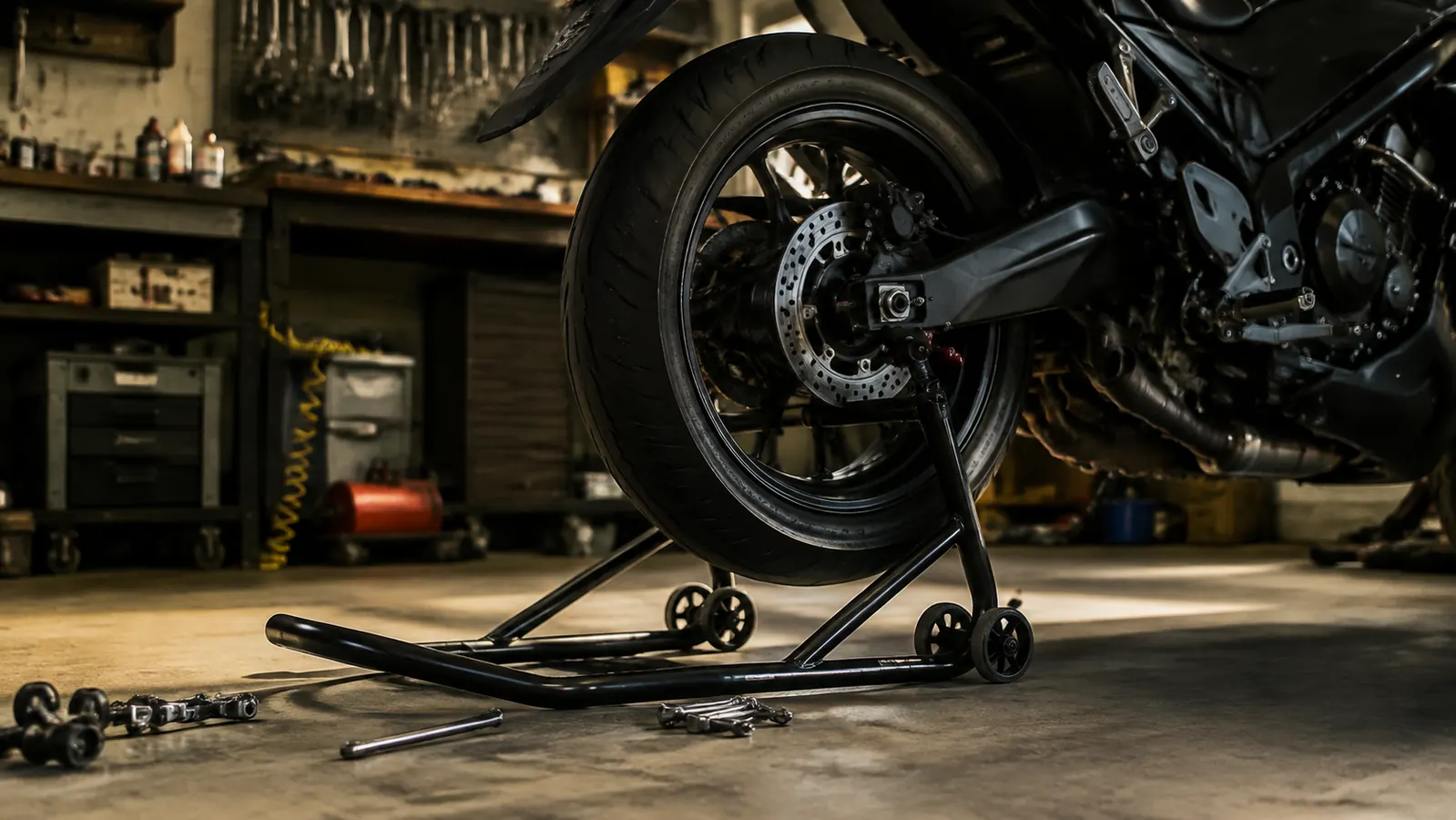
The moment you have to pull the rear wheel, the Groller is done and the VEVOR rear stand takes over. Lifting the wheel clear on a set of spools under the swingarm puts the axle, the chain adjusters, and the whole rear end in the open, where you can drop the wheel, torque the axle to spec, and button it back up. I do not want to torque my rear axle while the wheel is balancing on a roller. I want it hanging solid in the air where nothing moves. For tire changes, brake caliper work, and axle service, the VEVOR is the tool that makes the job safe, and safety is the whole point of a rear stand.
It is also the right answer for a fat rear tire. The Groller is capped around 240mm wide, and a big 200-series rear tire sits snug in that cradle. The VEVOR clears the tire entirely because it grabs the swingarm, not the rubber. If you build bikes with fat rear ends, a rear stand that ignores tire width is the one that fits everything in the shop. And for winter storage, the VEVOR keeps the tire off a cold concrete floor and the suspension unloaded, which is exactly what you want when a bike sits for months. That alone can save a flat spot on a soft compound tire.
VEVOR rear stands are also a common choice because they are inexpensive for what they do and they are everywhere, so accessories and spools are easy to find. Spools for the swingarm come in the usual sizes and are cheap to replace. If you plan to spend a winter doing a wheel bearing swap or a brake rotor replacement, this is the stand that earns its keep during the off-season, when the roller is just taking up floor space.
Start with the tool that earns the most use
If your bike is chain driven and you clean it on a schedule, the GRAND PITSTOP Groller is the stand you will actually reach for week after week. Check the current price and the ratings before you build your cart.
Amazon Check Today's Price on Amazon →Setup and Daily Fitment
Setting either one up starts the same way: level floor, the stand roughly under the bike, then a careful inch or two of lift while you check that nothing binds. The GRAND PITSTOP is the friendlier of the two for a first-time owner. You ride or push the rear wheel onto the rollers, set the wheel in the cradle, and it is ready. There are no spool mounts to fit and no adapters to sort, which matters if your bike does not already have spools bolted to the swingarm. It simply works out of the box.
The VEVOR asks a bit more of you on the first setup. You want the spools or paddles aligned with the swingarm mounts, and if the bike has no spools you are hunting for a set that fits the diameter and length before you can use it. Once it is fitted to your bike it is a non-issue, but the first time can be fiddly, especially if you swap it between bikes with different swingarms. It is not hard, it is just more setup than the roller. Neither stand tolerates an uneven floor, so if your garage floor slopes, block it level before you trust either one under a heavy bike.
The Value Question
When people ask me which to buy, the real question underneath is usually about money. The GRAND PITSTOP Groller is the cheaper of the two, and it is the one I would tell a beginner to start with, because it is the stand that makes the job you do most genuinely easier, and you do not have to spend much to get there. It also weighs less, stores flat, and does not need any per-bike accessories. If your budget only stretches to one stand this season, the roller is the one that pays you back fastest in time and back pain saved.
The VEVOR rear stand costs more, not because it is overpriced, but because it does a harder job. Lifting a motorcycle off the ground and holding a wheel off the floor takes more steel and more careful geometry than rolling that wheel in a cradle. That extra cost buys you the ability to pull a wheel, and you cannot put a dollar figure on not fighting a bike balanced on a floor jack. If your season is mostly chain maintenance, the value leans heavily toward the GRAND PITSTOP. If your season involves tire and brake work, the rear stand earns its higher price.
Where They Both Fall Short
Neither of these is a front stand, and if you are doing fork work or a front wheel you still need the correct front-end tool on top of whatever you choose here. The Groller only touches the rear wheel, and the VEVOR rear stand only lifts the back. I have also found that both can be fussy about the exact point they contact the bike. On the Groller, a very wide or very soft rear tire hunts a little in the cradle, and you want the bike on level ground so it does not roll off. On the VEVOR, the spool position and the swingarm width matter, and if the bike has no spool mounts you are shopping for adapters before you can use it.
Who Should Buy Which
If you clean and lube your chain every few hundred miles and you are tired of doing it on your knees with the bike on its side stand, get the GRAND PITSTOP Groller. It is inexpensive, it is the tool you will use the most, and it makes the most repeated maintenance job on your bike genuinely easier. I would not do a season of chain cleaning on any bike without one now. If you do rear-end work, wheel swaps, tire changes, or park the bike for the winter with the wheel off the floor, get the VEVOR style rear stand. It is the tool for anything that has to come off or hang free.
And if you actually wrench on your own bike, which I assume is true since you are reading this, you will eventually want both. Start with the GRAND PITSTOP because it is the one you will use every couple of weeks, then add the VEVOR when a wheel has to come off. Buy them in that order and neither one collects dust. For a chain-driven motorcycle that lives in your garage, that is about as honest a recommendation as I can give you.
The one that earns its spot first
Start with the GRAND PITSTOP Groller for the job you do every couple of weeks, then add a rear stand when a wheel has to come off. Compare today's price and read the reviews here.
Amazon Check Today's Price on Amazon →